Learn to trade like the banks
See Why Your Stop Gets Hit Right Before Price Reverses
Finally Understand Why the Market Does What It Does
You're not bad at trading. You've been taught to look in the wrong place.
It isn't your discipline or your strategy. Price moves where the big orders are — and nobody ever showed you how to see them.
Instant PDF download · 30-day money-back guarantee
Why traders keep losing
You've watched price hit your stop, then reverse exactly where you said it would.
You've bought the ‘breakout’ — and been trapped at the top.
You've sold the ‘reversal’ — and watched the trend carry on without you.
So you do what every trader does. Another strategy. Another indicator. Another YouTube guru. You tighten your rules and blame yourself.
But what if every one of those losing trades had the same cause?
The Chart That Changes Everything
This is what a bank selling looks like — if you know how to read it.
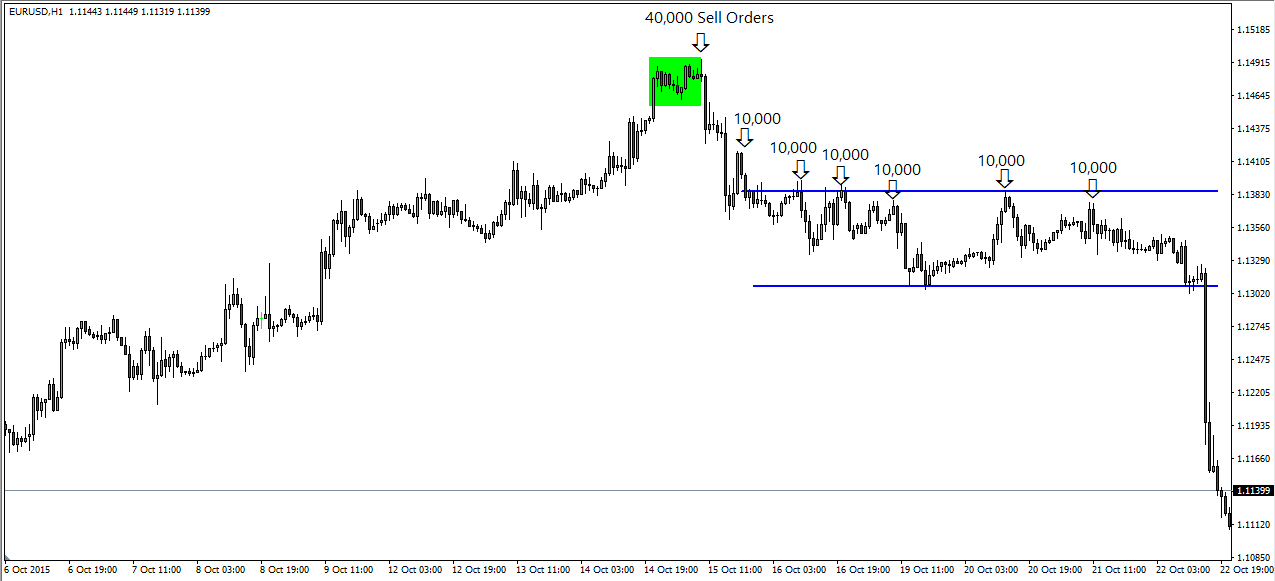
Figures are illustrative, used in the guide to explain the process.
A bank can't just click ‘sell’. Its orders are so big that each one has to be matched with someone else buying. No buyers, no trade.
So where do the buyers come from? From you — and every other retail trader who sees a strong uptrend and piles in long.
1.
The trap is set.
Price has trended up for days and the move is getting steeper. Retail traders are buying because 'the trend is your friend'.
2.
The biggest order goes first.
Say an institution wants to sell 100,000 units. At the top, only around 40,000 buy orders are available — so that's all it can fill. The sell consumes every buyer, and price drops.
3.
The 'bounces' aren't bounces.
It still has 60,000 to sell, and the crowd is less keen to buy. So each time price swings back up, it sells another chunk into the buyers. That's why the swing highs line up at almost the same price.
4.
The real move.
With the full position filled, there's nothing left holding price up. The traders who bought those bounces are now trapped — and as they close at a loss, their sell orders fuel the collapse.
Every ‘the uptrend is resuming’ signal on that chart was someone else's entry. The traders buying it were the liquidity.
Once you see this, you can't unsee it. The guide shows you the whole playbook — where institutions enter, where they take profit, and why price does the ‘irrational’ things that keep stopping you out.
48-Page Market Understanding Guide
“You’ve seen one pattern. The guide shows you the whole playbook.”
Where institutions enter, where they take profit, and why price does the ‘irrational’ things that keep stopping you out.
Instant PDF download · 30-day money-back guarantee

Why this guide exists
I thought I was bad at trading, too.
I started trading in 2011.
I did everything I was told. I finished BabyPips. I watched every YouTube video. I searched for the ‘secret’. I paid £100 a month to a mentor teaching news trading on NFP and CPI with live squawks, and £150 a month to another for day trading. Technical analysis, fundamentals, even the COT report — I tried it all.
Every time I lost, the mentor had a reason. Nothing changed.
I had good patches. But I also blew more accounts than I'd like to admit — over-leveraging, piling into trades I thought were ‘at a discount’, and one stretch trading oil and the Dow where I lost over $20,000.
The money hurt. The years hurt more. Trading is lonely when it's going wrong. You can't really talk about a loss like that at the dinner table — and I couldn't even explain to myself why it kept happening.
Eventually it stopped being about the money. I just wanted to understand why price moves.
That led me to a manual on a small corner of the internet, describing how large institutions in the world's financial centres use retail traders and other participants to fill the orders they need to place.
Not long after, I joined a gym whose owner had been a Swiss banker. I told him what I'd read and asked if he'd help me. He laughed at me — in front of everyone in reception — and asked why he would.
But while he was boasting about a call on the Turkish lira, he pulled out a sheet of paper covered in numbers and calculations, and started marking them onto the chart on his screen.
That's when it clicked. He wasn't trading patterns or indicators. He was working with orders. And in over a decade in the retail world, I'd never heard anyone talk about it.
Today I trade completely differently. I don't chase quick trades in and out. I wait — patiently — for signs that institutions are accumulating, and for the places where other traders are getting caught out and creating the orders the big players need.
I've come to think trading is like amateur tennis: you don't win by hitting winners. You win by making fewer mistakes than the other side.
This guide is the understanding I wish I'd had in 2011. It won't hand you a system. But it will show you what you've been trading against.
— Andreas Stavrou, founder of Rethink Forex
 Passed the FTMO Challenge.
FTMO challenges are traded on a simulated account. Past performance does not guarantee future results.
48-Page Market Understanding Guide
“The understanding I wish I’d had in 2011.”
48 pages. Real annotated charts. No indicators, no signals — just how the market actually works.
Instant PDF download · 30-day money-back guarantee
The 48-Page Guide
Inside, you'll learn the whole playbook
- 1
The Three Decisions Every Trader Makes
Why institutions face the same decisions as you — but can't act until the orders exist.
- 2
When Institutions Place Their Trades
The trend as bait, shown on a real five-year USD/JPY reversal.
- 3
Locating Institutional Entries
How to find where a move truly originated, and mark the zone price is likely to return to.
- 4
Spotting Profit-Taking
The structural shift that shows institutions cashing out, often before the crowd notices.
- 5
How Institutions Build a Reversal
Split orders, the biggest trade first, and why price chops before it turns.
- 6
How Institutions Set Each Other Up
Trading sessions, volume, and why the London–New York overlap matters.
Plus annotated real-market charts throughout, and a recap at the end of every chapter.
You'll discover:
- →Why the trend you were taught to follow is the exact condition institutions wait for before they enter (p.8)
- →Why a bank won't place a trade until enough retail traders are positioned to lose (p.6)
- →Why your stop below an obvious swing low is fuel, not protection (p.45)
- →The simple way to find where institutions entered — look for where the move originated, not where it broke out (p.19)
- →The timing rule for whether price is likely to return to an institutional zone, on daily and hourly charts (p.16)
- →Why institutions place their largest order first — and how that reveals a reversal in progress (p.31)
- →Why price whipsaws up and down before a real reversal, and which part of that chop is the trap (p.29)
- →How to spot profit-taking: the retracement that's bigger than anything before it in the move (p.26)
- →Why a big news spike like NFP is often the moment institutions finish buying, not start selling (p.15)
- →Why large range candles and pin bars pull traders in the wrong direction (p.23)
- →Why 'nothing happens' when only one session is open — and when the real moves tend to occur (p.43)
Is this guide for you?
It's for you if…
- You've tried several strategies and still feel one step behind the market
- You want to understand why price moves, not just follow another set of rules
- You're a beginner who wants to start with the right foundations — or an experienced trader who's stuck
It's not for you if…
- You want signals or trades to copy
- You're looking for a guaranteed-profit system (no such thing exists)
48-Page Market Understanding Guide
“Sounds like you?”
Start seeing what’s really moving price — tonight.
Instant PDF download · 30-day money-back guarantee
Buyer feedback
What buyers said
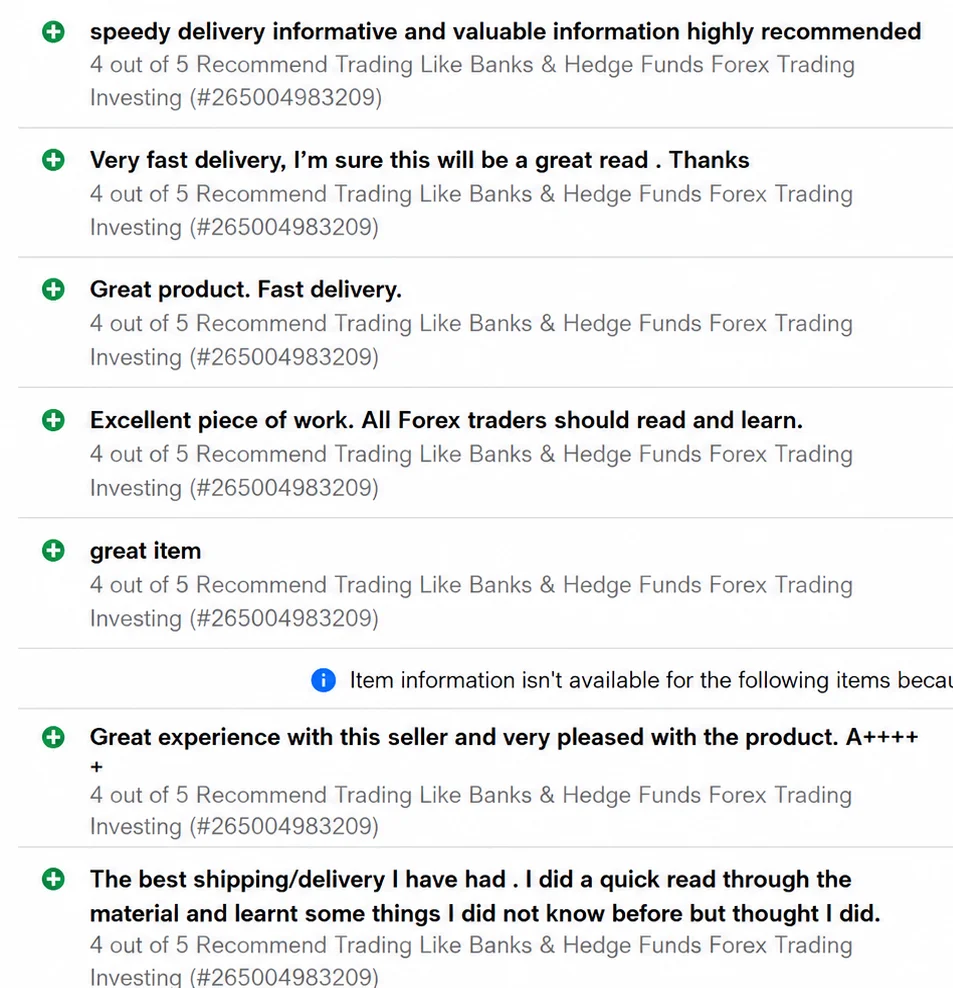
Verified eBay buyer feedback for an earlier edition of this guide, quoted word for word.
“I did a quick read through the material and learnt some things I did not know before but thought I did.”
Verified eBay buyer
“Excellent piece of work. All Forex traders should read and learn.”
Verified eBay buyer
“speedy delivery informative and valuable information highly recommended”
Verified eBay buyer
“Great experience with this seller and very pleased with the product. A+++++”
Verified eBay buyer
30-Day Money-Back Guarantee
Read it. If it doesn't change how you see a chart, get your money back.
Read the guide. Put it next to your own charts. If within 30 days you don't see price differently, email support@rethinkforex.co.uk and we'll refund your £25 in full. No questions asked.
— Andreas
Get Instant Access
Rethink Forex: 48-Page Market Understanding Guide
- Instant PDF download
- Annotated real-market chart examples
- Chapter-by-chapter recaps
- 30-day money-back guarantee
£25
Download Now — £25Secure checkout via Stripe · Pay by card or PayPal
FAQ